LCL vs FCL Shipping: Which Is Better for Your Business?
Strategic Freight Analysis, Cost Structures, and Transit Time Comparison
When importing commercial cargo or architectural materials from China, choosing the right ocean freight method makes an enormous impact on your shipping budget, delivery timeline, and overall supply chain efficiency.
The two primary sea freight shipping models are LCL (Less than Container Load) and FCL (Full Container Load). Understanding how each option works empowers you to choose the most economical and secure solution for your project.
1. What Is LCL Shipping?
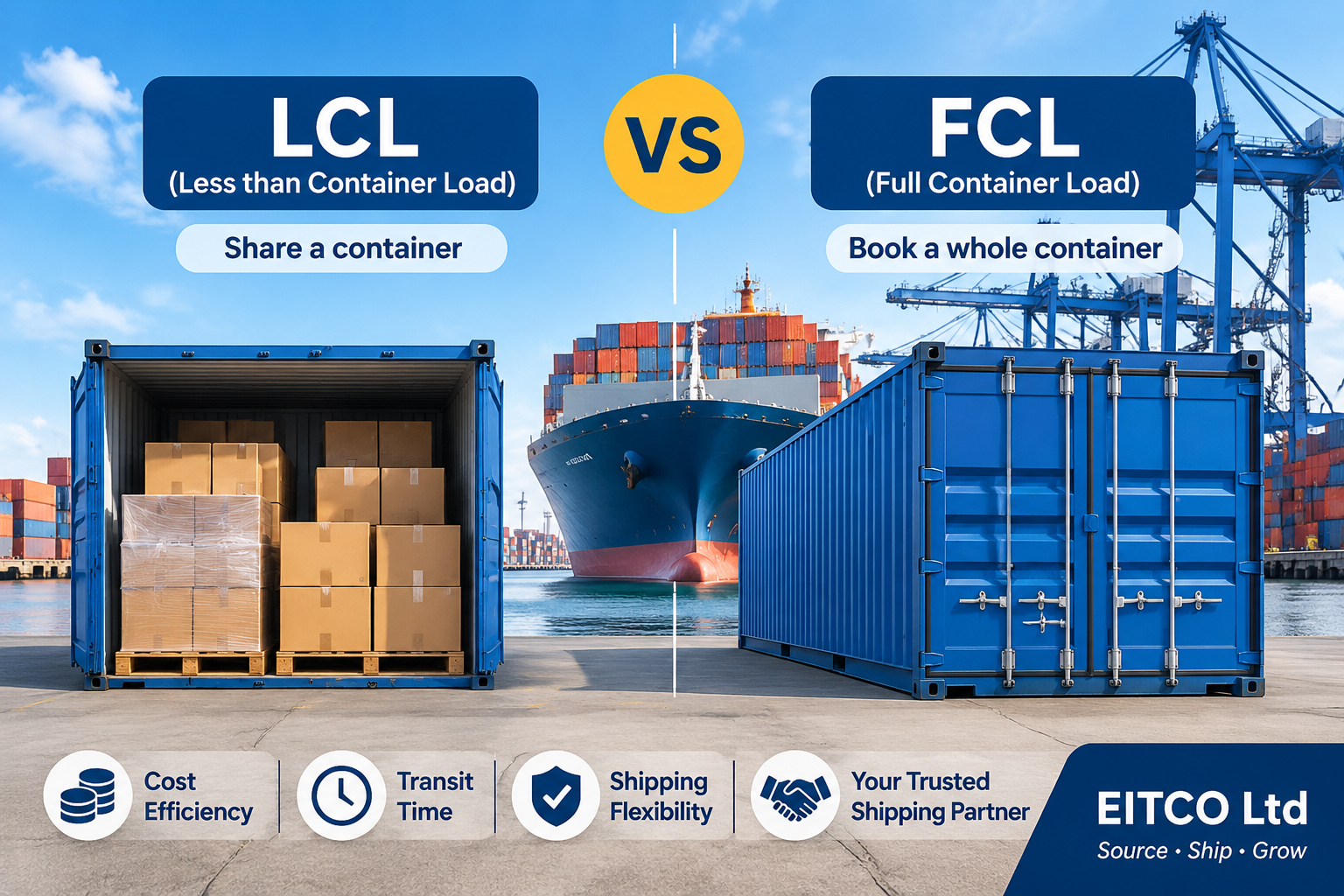
LCL stands for Less than Container Load. It means your cargo shares container space with shipments belonging to other international importers. This option is ideal when your order volume is insufficient to justify booking an entire 20ft or 40ft container.
- ✓ Advantage: Pay only for the specific cubic meters (CBM) or weight your cargo occupies.
- ✓ Advantage: High flexibility for small or trial orders without waiting to accumulate full container volume.
- ✓ Disadvantage: Cargo consolidation at departure and deconsolidation at destination ports can add 5 to 10 days to transit time.
- ✓ Disadvantage: Increased handling between warehouses raises the potential risk of package scuffing unless crated securely.
2. What Is FCL Shipping?
FCL stands for Full Container Load. You book an exclusive, dedicated shipping container (typically 20ft, 40ft, or 40ft High Cube) solely for your cargo, regardless of whether you utilize every cubic meter.
- ✓ Advantage: Maximum security—your container is loaded and sealed at the factory in China and remains untouched until arrival.
- ✓ Advantage: Faster transit times by bypassing consolidation freight stations.
- ✓ Advantage: Significantly lower freight cost per unit when shipping medium to large volumes.
- ✓ Disadvantage: Flat container rate is payable regardless of vacant volume inside.
3. LCL vs FCL: Direct Comparison
Here is a quick side-by-side comparison of key logistics factors:
| Logistics Feature | LCL (Shared Container) | FCL (Full Container) |
|---|---|---|
| Container Space | Shared with other shippers | Exclusive dedicated container |
| Best For | Small shipments (1 – 15 CBM) | Volume orders (> 15 – 20 CBM) |
| Pricing Model | Per Cubic Meter (CBM) or Ton | Flat rate per container size |
| Cargo Handling | Multiple transfers (CFS warehouses) | Direct loading and factory sealing |
| Transit Time | Slower (consolidation overhead) | Fastest direct ocean route |
| Cargo Security | Requires heavy-duty wooden crating | Lowest risk of handling damage |
4. Which Shipping Method Should You Choose?
Select LCL when shipping small quantities, testing newly sourced products, or managing smaller inventory replenishments.
Select FCL when shipping complete residential architectural packages (doors, windows, and cabinetry), bulk commercial orders, or when scheduling and cargo integrity are critical.
Crucial Advice: Always evaluate the complete landed cost rather than ocean freight quotes alone. CFS destination charges, customs clearance, duties, and drayage determine your true bottom line.
Rule of thumb: If your shipment exceeds 15 CBM, booking a 20ft FCL container is frequently more economical and secure than LCL.
5. Ship Smarter with EITCO Ltd
Selecting between LCL and FCL is just one component of a successful import. EITCO Ltd manages supplier coordination, cargo collection, crating inspections, export customs clearance, and global ocean freight booking.
Whether you need three pallets shipped LCL or multiple 40ft High Cube containers shipped FCL, our team guarantees competitive rates and professional logistics management.
Looking to Source or Ship from China?
Whether you are ordering architectural doors, facades, custom millwork, or managing container logistics, EITCO Ltd provides on-the-ground factory audits, quality inspections, and international shipping.